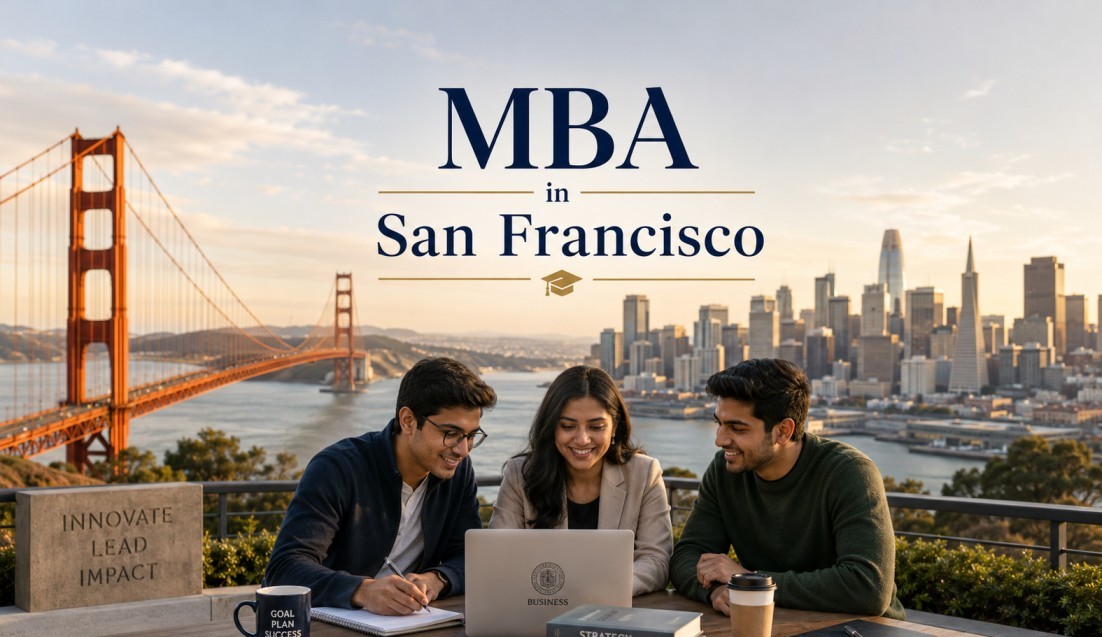
MBA in San Francisco
Table of Contents
- Top Universities for MBA in San Francisco
- Types of MBA in San Francisco
- Popular MBA Specializations in San Francisco
- MBA in San Francisco Fees for Students
- Eligibility for MBA in San Francisco
- Admission Process for MBA in San Francisco
- Cost of Living in San Francisco for International Students
- Scholarships for MBA in San Francisco
- MBA in San Francisco Intakes
- Student Visa for MBA in San Francisco
- Work Opportunities During MBA in San Francisco
- Jobs After MBA in San Francisco
- Final Thoughts from Author
Pursuing an MBA in San Francisco gives students access to one of the world's leading business, technology, and innovation hubs.
With globally recognised business schools, strong connections to Silicon Valley, and MBA specialisations in technology, finance, entrepreneurship, consulting, and analytics, students benefit from excellent networking opportunities and career growth.
The city is home to well-known institutions such as the University of San Francisco, Golden Gate University, and Stanford Graduate School of Business, while globally ranked universities like UC Berkeley Haas and Stanford Graduate School of Business are located nearby.
The table below gives a quick overview:
Key Point | Details | Approx. Value |
Study Destination | San Francisco, California | Major U.S. business hub |
QS MBA Ranking | University of San Francisco (Masagung) | USA =71, Global #201-250 |
Course Level | Master's Degree | MBA |
Duration | Full-time | 1-2 years |
Tuition Fees | Depends on university | $29,000-230,000+ (≈ ₹28 L-₹2.2 Cr) |
Work Experience | Preferred | 2-5 years |
Student Visa | F-1 Visa | Required |
Career Scope | Tech, Consulting, Finance, AI, Startups | Industry-based salaries |
This article covers universities, MBA formats, fees, eligibility, admission process, scholarships, living costs, student visa, career opportunities, and jobs after MBA in San Francisco.
Top Universities for MBA in San Francisco
The San Francisco is home to several globally recognised business schools offering MBA programs in different formats and specialisations.
Students can choose from universities in San Francisco as well as nearby institutions across the Bay Area, with options ranging from affordable public universities to internationally ranked business schools.
The table below compares the top universities for MBA schools in San Francisco:
University | Global Recognition | Approx. Tuition Fees |
University of San Francisco (Masagung) | QS Global MBA Rankings 2026: #201–250 | $86,400 (≈ INR 82 L) |
Stanford Graduate School of Business | Top Global MBA School | $89,187/year (≈ INR 85 L/year) |
UC Berkeley Haas | Top Global MBA School | $76,788-89,033/year (≈ INR 73 L-INR 85 L/year) |
offering flexible MBA programs | Course-wise fees apply | |
San Francisco State University | AACSB-accredited business programs | ≈ $9,000-41,000 (≈ INR 28 L-INR 39 L) |
Types of MBA in San Francisco
San Francisco offers a wide range of MBA programs to suit different career goals and professional experience.
Students can choose from Full-time, Part-time, Executive (EMBA), and Online MBA programs, depending on their schedule and career stage.
With close access to Silicon Valley, leading technology companies, financial firms, and startups, MBA students benefit from strong industry exposure, networking opportunities, and career-focused learning.
The table below compares the common MBA formats:
MBA Type | Duration | Best For |
Full-time MBA | 1-2 years | Career switchers |
Part-time MBA | 2-4 years | Working professionals |
Executive MBA | 20-24 months | Senior managers |
Online MBA | 18-36 months | Flexible learning |
Popular MBA Specializations in San Francisco
San Francisco's economy is driven by technology, finance, artificial intelligence, consulting, and entrepreneurship.
As a result, the best MBA specializations include Technology Management, Entrepreneurship, Finance, Business Analytics, and Strategy, as these align well with the Bay Area’s startup ecosystem, tech companies, and venture capital market.
The table below highlights the popular MBA specializations:
MBA Specialization | Common Career Path | Universities Offering |
Technology Management | Product Manager | Stanford GSB, UC Berkeley Haas, University of San Francisco |
Business Analytics | Data Analyst | University of San Francisco, Golden Gate University |
Entrepreneurship | Startup Founder | Stanford GSB, UC Berkeley Haas |
Finance | Investment Banker | UC Berkeley Haas, University of San Francisco |
Marketing | Brand Manager | University of San Francisco, Golden Gate University |
Supply Chain Management | Operations Manager | Golden Gate University |
Healthcare Management | Healthcare Consultant | University of San Francisco |
MBA in San Francisco Fees for Students
The cost of studying an MBA Colleges in San Francisco depends on the university, program format, and duration.
MBA fees in USA vary significantly across business schools, with globally ranked institutions such as Stanford GSB and UC Berkeley Haas generally charging higher tuition fees than public universities and specialised MBA programs.
The table below shows the estimated tuition fee range:
University / MBA Program | Approx. Tuition Fees | INR Value |
University of San Francisco MBA | $86,400 total | ≈ INR 82 L |
Stanford Graduate School of Business | $89,187/year | ≈ INR 85 L/year |
UC Berkeley Haas MBA | $76,788-89,033/year | ≈ INR 73 L-INR 85 L/year |
San Francisco State University MBA | ≈ $29,000-41,000 | ≈ INR 28 L-INR 39 L |
Wharton Executive MBA, San Francisco | $230,000+ total | ≈ INR 2.2 Cr+ |
Eligibility for MBA in San Francisco
Eligibility requirements vary by university and MBA format. Most MBA Programs in San Francisco require a recognised bachelor's degree, English language proficiency, professional experience, and supporting application documents. Highly ranked business schools may also require GMAT/GRE scores.
Academic Requirements for MBA in San Francisco
Most universities require applicants to have a recognised bachelor's degree or an equivalent qualification.
Competitive business schools also consider academic performance, leadership potential, and professional experience.
Depending on the university, applicants may need a minimum GPA, work experience, and proof of English proficiency, while some institutions offer GMAT/GRE waivers for eligible candidates.
The table below explains the common academic requirements:
Requirement | Details |
Bachelor's Degree | Recognised undergraduate degree |
GPA | Around 3.0/4.0 preferred |
Academic Background | Any discipline accepted by many universities |
Transcripts | Official academic records |
Leadership Profile | Preferred by top universities |
Work Experience | 2–3 years |
Also Read: MBA in USA Without Work Experience
English Language Requirements for MBA in San Francisco
To study for an MBA schools in San Francisco, International students usually need to submit an English language test unless they qualify for an exemption.
Accepted tests include IELTS, TOEFL, PTE Academic, and Duolingo English Test.
The table below shows common English language requirements:
University | English Requirement | Student Tip |
University of San Francisco | IELTS 6.5+, TOEFL 92+ | Check program requirements |
San Francisco State University | IELTS 6.5+, TOEFL 88+ | PTE also accepted |
Stanford GSB | University requirements apply | Review official admissions page |
UC Berkeley Haas | Graduate School requirements | Course-specific |
Golden Gate University | Accepted English tests required | Waivers may apply |
GMAT/GRE Requirements for MBA in San Francisco
GMAT and GRE requirements for MBA programs in San Francisco vary by university.
While some business schools require competitive test scores, others follow a test-optional policy or offer waivers for eligible applicants based on their academic or professional background.
The table below provides a quick comparison.
University | GMAT/GRE Requirement | Student Tip |
Stanford GSB | Required | Competitive scores recommended |
UC Berkeley Haas | Required | Limited waiver options |
University of San Francisco | Test Optional | Submit if it strengthens your profile |
Golden Gate University | Usually Not Required | Holistic admission |
San Francisco State University | Required / Waiver Available | Experience-based waivers |
Admission Process for MBA in San Francisco
Applying for an MBA colleges in San Francisco involves meeting the university's admission requirements and completing the application before the deadline.
Most business schools accept online applications and may also require supporting documents, an interview, and proof of English language proficiency.
The table below explains the admission process:
Step | What You Need to Do | Important Detail |
1. Choose University | Compare ranking, fees, and MBA format | Match with career goals |
2. Check Eligibility | Review academic and English requirements | Use official university website |
3. Prepare Documents | SOP, Resume, LORs, Transcripts | Keep scanned copies ready |
4. Apply Online | Complete university application | Pay application fee if applicable |
5. Attend Interview | If invited | Required by some universities |
6. Accept Offer | Confirm admission | Deposit may be required |
7. Receive Form I-20 | Issued by university | Required for F-1 visa |
8. Apply for Student Visa | Submit visa application | Apply early |
Cost of Living in San Francisco for International Students
Besides tuition fees, students should budget for accommodation, food, transport, utilities, and personal expenses.
San Francisco is one of the most expensive cities in USA, so financial planning is essential before starting your MBA.
The table below gives an estimated monthly cost of living:
Expense Category | Approx. Monthly Cost | Approx. INR Value |
Single Person Cost, excluding rent | $1,583/month | ≈ INR 2 L/month |
Accommodation | $1,600-3,600/month | ≈ INR 2 L- 3 L/month |
Food and Groceries | $350-700/month | ≈ INR 33,000- 67,000/month |
Transportation | $90-120/month | ≈ INR 9,000-11,000/month |
Utilities and Internet | $240-380/month | ≈ INR 23,000- 36,000/month |
Source: Numbeo
Scholarships for MBA in San Francisco
Several universities offering MBA programs in San Francisco provide scholarships based on academic performance, leadership, professional experience, and financial need.
Many merit-based scholarships are automatically considered during the admission process, while some require a separate application.
International students can also apply for external scholarships offered by foundations and organisations.
The table below highlights major scholarship opportunities:
Scholarship | Eligibility | Coverage |
University of San Francisco Merit Scholarships | Eligible MBA applicants | Partial tuition |
Berkeley Haas Scholarships | Merit & need-based | Varies |
Stanford GSB Fellowships | Need-based | Varies |
Forté Fellowships | Women MBA students | Tuition support |
The Consortium Fellowship | Eligible diversity applicants | Full/Partial tuition |
MPOWER Scholarship | International students | Varies |
MBA in San Francisco Intakes
Most MBA programs in San Francisco primarily offer a Fall intake, while some universities also provide Spring or rolling admissions, depending on the program.
Application deadlines usually fall between October and May, with multiple admission rounds at many business schools.
The table below provides a general overview:
University | Major Intake | Admission Cycle |
University of San Francisco | Fall, Spring | Multiple rounds |
Golden Gate University | Multiple Intakes | Rolling Admission |
San Francisco State University | Fall, Spring | University deadlines |
UC Berkeley Haas | Fall | Round-based admission |
Stanford GSB | Fall | Multiple application rounds |
Student Visa for MBA in San Francisco
International students planning to pursue an MBA in San Francisco need an F-1 Student Visa.
After securing admission to a SEVP-certified university, they receive Form I-20, which is required to apply for the visa at a U.S. embassy or consulate in their home country.
Applicants must also meet the financial and documentation requirements set by the U.S. government.
The table below explains the student visa process:
Step | What to Do | Important Detail |
Receive Admission Offer | Accept your university offer | Required before I-20 |
Submit Financial Documents | Show proof of funds | Tuition and living expenses |
Receive Form I-20 | Issued by the university | Mandatory for visa |
Pay SEVIS Fee | I-901 SEVIS Fee | $350 (≈ INR 33,000) |
Complete DS-160 | Fill visa application form | Required for interview |
Pay Visa Fee | F-1 Visa Fee | $185 (≈ INR 18,000) |
Attend Visa Interview | Visit U.S. Embassy/Consulate | Carry all documents |
Receive Visa Decision | Wait for processing | Apply early |
Work Opportunities During MBA in San Francisco
Students on an F-1 visa can usually work part-time during academic sessions and full-time during scheduled university breaks, subject to visa rules.
They can also gain experience through on-campus jobs, internships, and approved training options such as CPT or OPT.
The table below highlights common part-time work options:
Part-Time Role | Common Work Area | Approx. Pay* |
Campus Assistant | University offices & events | $18-25 (≈ INR 1,700-INR 2,400)/hour |
Research Assistant | Academic departments | $20-30 (≈ INR 1,900-INR 2,900)/hour |
Library Assistant | University library | $18-24 (≈ INR 1,700-INR 2,300)/hour |
Retail Associate | Stores & supermarkets | $18-24 (≈ INR 1,700-INR 2,300)/hour |
Hospitality Staff | Cafés & restaurants | $18-26 (≈ INR 1,700-INR 2,500)/hour |
Student Ambassador | University recruitment | $18-28 (≈ INR 1,700-INR 2,700)/hour |
Note: Approximate hourly wages may vary depending on the employer and role.
Jobs After MBA in San Francisco
San Francisco offers strong career opportunities for MBA graduates, especially in technology, AI, finance, consulting, healthcare, and entrepreneurship.
The city's close proximity to Silicon Valley also creates opportunities with startups, multinational companies, and venture capital firms.
Salary in USA after MBA varies by location, role, and industry. In California, MBA graduates earn an average salary of over USD 150,000 (≈ INR 1.4) per year, while senior roles can offer significantly higher compensation.
The table below highlights common career options after completing an MBA:
Job Role | Common Industry | Approx. Annual Salary |
Product Manager | Technology | $170,000-220,000 (≈ INR 1.6-2.1 Cr) |
Management Consultant | Consulting | $165,000-230,000 (≈ INR 1.6-2.2 Cr) |
Business Analytics Manager | Technology and Analytics | $150,000-205,000 (≈ INR 1.4-2 Cr) |
Finance Manager | Banking and Finance | $150,000-210,000 (≈ INR 1.4-2 Cr) |
Strategy Manager | Corporate | $165,000-225,000 (≈ INR 1.6-2.1 Cr) |
Marketing Manager | Technology and Consumer | $145,000-200,000 (≈ INR 1.4-1.9 Cr) |
Source: Glassdoor
Final Thoughts from Author
An MBA in San Francisco is worth considering if you want to build a career in technology, finance, consulting, or entrepreneurship.
What makes this worthy is not just the universities but also the opportunity to learn and connect with companies based in and around Silicon Valley.
Before making a decision, compare universities based on the curriculum, total cost, scholarships, internship opportunities, and career support, not just rankings.
If you choose a program that matches your career goals and prepare your application early, an MBA in San Francisco can be a valuable investment for your future.
Planning to pursue MBA in San Francisco? Book a free 1:1 counselling session with our study abroad experts for personalised guidance.